Pages

Showing posts with label deep sea. Show all posts

Thursday, February 13, 2020

Bringing to Light, Creatures of Darkness

Danté Fenolio, Ph.D., has devoted his life to bringing rarely seen creatures to light through his beautiful and eerie photography.
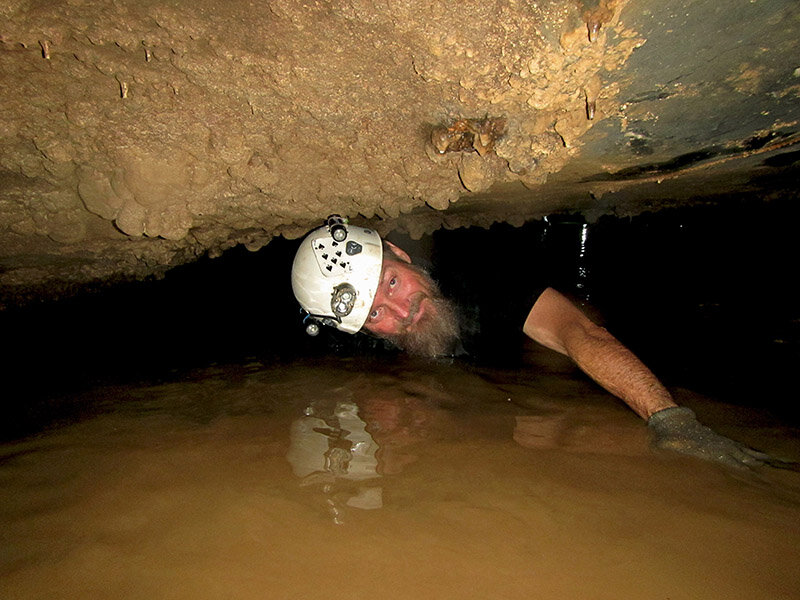
Danté Fenolio Caving in China
He's brought us images from habitats without light: caves, the bottom of the ocean, and the canopies of the rainforest. Not interested in the typical, but seeking out underappreciated and rarely seen creatures to highlight the need for conservation of the world's biodiversity.
Science Source Images is proud to represent several exclusive photographs from his collection. Discover a Fangtooth from the Gulf of Mexico, a colony of Siphonophore, orange and red-colored Jellies, transparent Batfish, blind albino Salamanders. Creatures so unusual, they may not seem real, but they are part of the wonder of our planet.
Fenolio is not only a successful author, adventure photographer, but runs the Conservation and Research Department at the San Antonio Zoo. His many projects to save animals and their habitats span the globe. Along with China, Peru, Japan, and Chile he works in the United States. His efforts range from the Ozarks, Oklahoma to Georgia.
Bringing focus to blind cave fish, Japanese Giant Salamander and endangered Chilean amphibians.

Tuesday, May 1, 2018

Deep Sea Exploration

A Telescope Fish has eyes that can track bioluminescent prey.

The world can feel like a small, crowded place, but actually, two-thirds of the planet remains relatively unexplored. Over 1,500 people have climbed Mount Everest, but only THREE have gone to the deepest part of the ocean.

Up until recently, we haven't had the technology to fully study and explore the oceans, but the race is on. Why is this so urgent? Over 70% of the oxygen we breathe comes from marine life such as plankton. Due to increased CO2 (carbon dioxide), pollution and other manmade changes to the environment, plankton may end up on our endangered species list one day.


To protect plankton, marine life and the oceans overall, we first need to understand what is normal, how things are changing, how fast and why. We know that the oceans dissolve much of the excess CO2 that humans create. But this makes oceans more acidic, damaging and killing coral and plankton, and adversely affecting much other marine life.

The biggest challenge in deep-sea exploration has always been the increased pressure the deeper one goes. Most divers comfortably go no further than 130 feet before succumbing to the eventually fatal pressure. The deepest part of the ocean, an area called Challenger Deep near Guam, is about 36,200 feet deep.


The first submarine was built in 1620 by Dutch inventor Cornelius Drebbel. It traveled along the banks of the Thames River in London, diving to a depth of 15 feet.  In 2012, filmmaker James Cameron descended to a depth of 35,756 ft in the DSV Deepsea Challenger, a deep-diving submersible. He was only able to stay at the bottom about an hour, before having to resurface. This submersible is as long as a limousine but can carry only one person in it's 43" diameter pilot sphere.

New unmanned robots called mini autonomous underwater vehicles are being used more often. Many of them can be released at once and send back data over a period of time.

One of the most fascinating and surprising things scientists are discovering is the prevalence of biofluorescent creatures. Even tetrapods, such as sea turtles have been found to glow in the dark of the ocean. Unlike bioluminescent creatures, which make their own light through a chemical reaction, biofluorescent creatures glow when certain wavelengths of light shine on them.

Scientists have discovered over 250 species of fish that use biofluorescence and believe this may be a method of communication in the deep ocean.
As we learn more about the oceans, hopefully, we can learn how to save them and also ourselves from extinction.


UnSeen Oceans Exhibit, American Museum of Natural History
nationalgeographic.org
deepseachallenge.com
Deepsea_Challenger, wikipedia.org

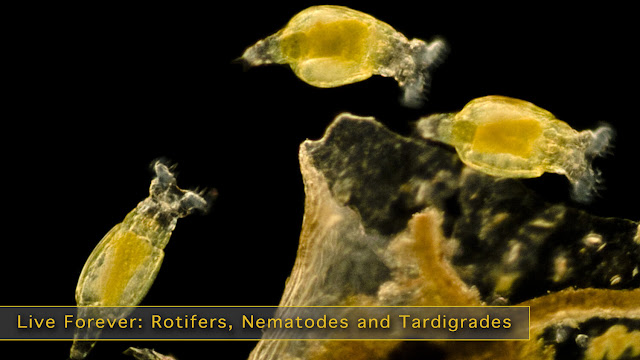
Rotifers, Nematodes and Tardigrades Stock Microscopic Photography

 Roti fers (Philodina sp.), Light Micrograph The bdelloid rotifer, found in freshwater habitats all over the world, is able to withstand ex...