Pages

Showing posts with label video. Show all posts

Thursday, May 16, 2019

NASA and the Space Age


In 1957, an amazing spectacle appeared in the North American night sky – Sputnik, the first satellite to enter Earth’s orbit. The USSR had successfully sent a rocket into outer space, thus beginning the space race, an event which would last a decade and challenge the best and brightest of two nations.

In response to Sputnik, President Dwight D. Eisenhower created NASA, the first American administration for space exploration in 1958. With Project Mercury, NASA attempted to make the first manned mission into space but failed to beat the Russians, who sent Yuri Gagarin into orbit in 1961. A month later Alan Shepard became the first American in space and John Glenn followed soon after, orbiting the Earth three times in 1962.

Gallery of NASA Stock Images and Videos

In the Sixties, NASA entered a new era. With the cold war raging and the threat of nuclear armament on the horizon, President John F Kennedy vowed to redouble NASA’s efforts and put an American on the moon by the end of the decade. In 1965, NASA began the Spacelab project, sending the first space station into Earth’s orbit. Despite sustaining damage during take off, the station was repaired in space and orbited the Earth until 1979.

The success of Spacelab led to NASA’s famous Apollo missions to the moon. After many failed attempts, Apollo 8 became the first shuttle to circle the moon in 1968. The following year, the USSR accomplished its first moon tour, leaving the space race at a stalemate.

Astronomy phone cases, tote-bags and more!

With the cold war raging in the east, astronauts Buzz Aldrin and Neil Armstrong of Apollo 11 successfully landed on the moon in 1969. The mission effectively ended the space race and cemented America’s place as the world leader in space exploration. Buzz Aldrin and Neil Armstrong became national heroes and were awarded the Presidential Metal of Freedom later that year.

Since then, NASA has continued its exploration of space sending probes to every planet in our solar system, including the dwarf planet, Pluto. It also landed four rovers on Mars, the last of which, Curiosity, is still collecting data from its craters today.

The recent image of a black hole in the M87 galaxy is more proof of human potential in space exploration. For the Space Age to advance, we must continue NASA’s legacy into the future. For more astronomy images check out the gallery above, and for unique astronomy gifts check out our store front below.

Astronomy Phone Cases, T-shirts and More

nasa.com
nytimes

Tuesday, December 4, 2018

One Hundred Years of the Flu

100 years ago one of the deadliest natural disasters hit humanity, killing approximately 4 percent of the earth's population. Even people in remote Pacific Islands and the Arctic met their demise due to this virus. This shocking number of deaths was caused by the flu, although these days most healthy people take the flu lightly.

That particular strain, the H1N1 influenza virus, commonly known as the Spanish Flu, claimed many young as well as many previously healthy adults. Additionally, since it arrived on the heels of the Great War, many people were malnourished, living in overcrowded medical camps with little access to good hygiene.

Royalty Free and Rights Managed Stock Images of the Flu

Government censorship may have played a role in the pandemic. To appear strong, many governments didn't reveal how devastating the flu was, giving no warning to the public to protect themselves. In Spain this information was not censored, giving the world the false impression that the Spanish were harder hit than the rest of the world. Thus the common moniker of the H1N1 strain in 1918 was the Spanish Flu.

These days you can walk into the corner drug store and within a few minutes walk out inoculated against the flu. Each year scientists update the formula to keep up with the ever-mutating virus strains.

In addition to the vaccine, we now know to take more steps to minimize infection. These precautions include washing our hands frequently, not touching our faces, standing at least six feet from anyone with the flu, nor touching an infected person’s phone, keyboard or other personal items. In a more general sense, we know to keep our immune systems healthy by getting enough sleep, eating right and regulating stress factors.

How can you tell if someone has the flu, not just a bad cold? Ultimately, without a medical test it is impossible to tell precisely, but here are a few guidelines.

Virus Coffee Mugs,Tote Bags and Other Gifts

Common cold:

  • comes on gradually

  • rarely have a fever

  • mild aches

  • sore throat and runny nose are common


The Flu:

  • sudden onset

  • high fever with chills

  • body aches

  • fatigue

  • headaches

  • sore throat and runny nose are rare

Most people recover from the flu on their own and suffer no complications. But one of the main reasons to avoid contracting it is to avoid passing it on to family and friends who are elderly, very young or otherwise susceptible to disease.

Late autumn is the perfect time to get your flu shot. It only takes a few seconds and you'll be covered until the next flu season.


  • webmd.com
  • cdc.gov

Monday, September 24, 2018

Science in Motion – The History of Discovery in Video Montage


Have you ever wanted to step into an old etching and explore the laboratories of your favorite scientists and inventors? Short of magic, video montages provide the next best thing!
Peer into Herschel’s telescope as he gazes at the cosmos from his observatory or follow a beam of light as it refracts into a rainbow in Newton’s laboratory.
Beyond the fun, video montages have an educational value. By linking images together, montages provide historic continuity, allowing people to see the connections between scientific discoveries. An etching from Isaac Newton’s life may tell you something about his findings in optics, but a group of images reveals how they led to further insights into physics.

 Astronomy mugs, t-shirts and more!

Astronomy mugs, t-shirts and more!
Montages also bring clarity to scientific discoveries. By zeroing in on a lab experiment, montages highlight key components involved in the scientific process. Panning and scrolling help viewers understand the causes and effects involved in experiments, giving them a better understanding of how science works.
As classic images enter the digital sphere, video montages are providing a unique and fun visual aid for designers and educators alike. Take a closer look below!

Monday, July 30, 2018

Phytoplankton & CO2


One group of creatures produces 70% of the earth's oxygen and also consumes carbon dioxide at an amazing rate. They are phytoplankton, and most are tiny single-celled organisms.
Phytoplankton come in many shapes and forms. The majority are single-celled plants, but some are bacteria and others are protists. Common types of phytoplankton are cyanobacteria, green algae, diatoms, dinoflagellates, and coccolithophores.
Phytoplankton plays an important role in human life in that they produce 70% of the oxygen we breathe. A much greater amount than terrestrial plants.
They are part of the carbon cycle, as they consume atmospheric carbon dioxide (CO2). CO2 resides naturally in the atmosphere, but human beings, mostly through the burning of fossil fuels, have released ever greater amounts into the atmosphere.

Stock Images and Stock Video of Phytoplankton

Along with CO2, phytoplankton need sunlight and other nutrients to survive.
At certain times, phytoplankton grow at an explosive rate over the course of days or weeks, creating what is called a "bloom." These blooms may last several weeks, even though an individual phytoplankton lives only for a few days. Despite being of a microscopic size, Phytoplankton blooms are so large they are clearly seen and photographed from satellites.
Aside from providing oxygen, phytoplankton are a major part of the food chain which includes everything from tiny zooplankton to shrimp, jellyfish, fish and whales.

Plankton Beach Towels, Tote Bags and More


Sometimes, phytoplankton can produce biotoxins, killing marine life and people who eat this marine life. "Red tides" are a type of toxic algal bloom. Once the bloom is over, the bacteria feeding on the dead phytoplankton deplete the oxygen in the water, thereby suffocating other animals.
These tiny creatures are truly a fascinating link in the chain of life.


www.diatoms.org
earthobservatory.nasa.gov
oceanservice.noaa.gov

Monday, May 14, 2018

Volcanic Eruptions: Kilauea and Beyond


A wall of lava flows down Hoʻokāpu Street on Hawaii's Big Island, engulfing cars and setting trees ablaze – one of many scenes of havoc following the eruption of Kilauea in May.

Deriving their name from the Roman god of fire, Vulcan, volcanoes live up to their reputation as one of nature's most fearsome phenomena. Literally openings in the earth's surface, volcanoes exist throughout the world, including underwater. 

Images & Video of Kilauea and Other Volcanos

Volcanoes usually occur where tectonic plates separate but they can also arise from hot spots in the earth's crust, such as in the Hawaiian Islands and Yellowstone National Park. When pressure builds up and travels to the earth's surface, an eruption occurs that can last between one hour and hundreds of years. The Island of Stromboli's volcano has been continuously active for over 2,000 years.

In addition to lava, ash and fire, eruptions are often accompanied by earthquakes, mudslides, and acid rain, causing massive damage to the surrounding environment. The 1980 eruption of Mount St. Helens destroyed 200 houses, 15 miles of highway and 4 billion board feet of timber.

Volcanic eruptions are not solely destructive, however. The lava they produce can clear away brush and treat the soil, making the land highly fertile for new plants and agriculture.

Custom Gifts for Science Geeks

  • nationalgeographic.com
  • bbc.com

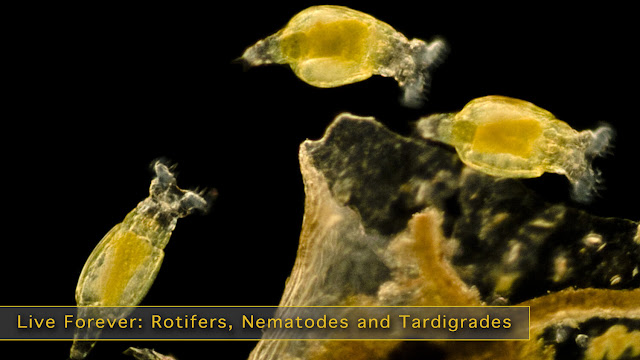
Rotifers, Nematodes and Tardigrades Stock Microscopic Photography

 Roti fers (Philodina sp.), Light Micrograph The bdelloid rotifer, found in freshwater habitats all over the world, is able to withstand ex...