Pages

Showing posts with label royalty free. Show all posts

Friday, September 8, 2023

Rotifers, Nematodes and Tardigrades Stock Microscopic Photography


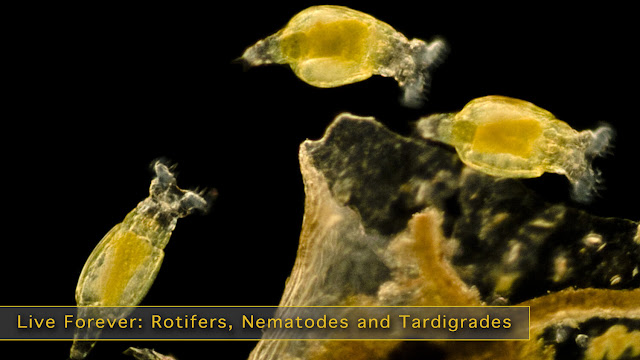
 Rotifers (Philodina sp.), Light Micrograph


The bdelloid rotifer, found in freshwater habitats all over the world, is able to withstand extreme cold. According to a recent discovery in northeastern Siberia, these multicellular organisms can be frozen for up to 24,000 years and live to tell the tale!

The average life span of us humans, 78 years, is not much compared to other creatures. Some birds live up to 100 years, eels have been recorded at 106, tortoises 150, and Koi fish over 200. The slow moving Greenland shark has been recorded at 512 years.

Still these are just flashes in the pan compared to rotifers. Scientists recently restored rotifers that had been frozen in the Siberian permafrost for over 24,000 years, meaning these creatures were alive during the Late Pleistocene Era - when Wooly Mammoths roamed the earth.

Stock Images and Video of Rotifers and Other Long-lived Animals

A rotifer is part of a group of seemingly invincible creatures, such as nematodes and tardigrades. Tardigrades have even been sent to outer space and survived.

Rotifers are a type of microscopic animal that is often found in zooplankton in either freshwater or saltwater. Rev. John Harris, in 1696, was the first to mention these creatures. They are commonly referred to as wheel animals due to the motion of the cilia surrounding their mouths, which looks like a spinning wheel.

Rotifers are filter feeders that eat dead bacteria and other decaying organic matter. When they move around, they compress their bodies into round shapes and extend out into a long thin shape. In terms of size they can range from 50 micrometers to over 2 millimeters.


Thursday, January 28, 2021

The Importance of Protein Folding


Friday, December 20, 2019

The History of Christmas

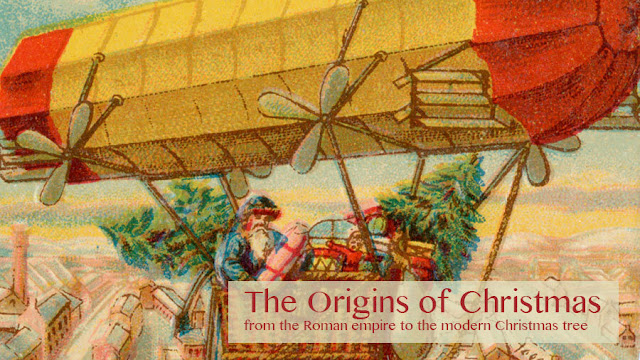
an image of a blimp delivering christmas gifts, etching


As people put up Christmas trees and decorate their homes, it’s easy to believe these traditions have been around since the year one, but Christmas and the holidays surrounding December 25th have taken many forms.

The origin of Christmas comes from three sources: it is the date of the winter solstice on the Roman calendar, it is about nine months from the vernal equinox (March 25th) and it is the date set for the birth of Christ.

Before Christendom the Roman Empire celebrated Saturnalia, a holiday honoring the Roman god, Saturn, the farther of Jupiter. During Saturnalia social customs were flipped upside down. Slaves ate at their master’s tables, women flirted with men and gambling was permitted. Saturnalia also involved public banquets and gift giving, which may have influenced later Christian traditions. There were even reports of naked caroling!

Origins of Christmas stock Image Gallery

Cards, prints, tote-bags and more

The Christmas tree has its origins in 16th century Germany. While writing a sermon at night in a starry evergreen forest, the Protestant Christian reformer, Martin Luther, is said to have added lighted candles to a tree and put it into his house. Other Protestant Germans brought similar trees into their homes and the tradition spread. By the second half of the 19th century, the tradition had moved beyond Germany, first among the upper classes and eventually into lower areas of society.


While you are making your shopping rounds this holiday season, attending religious services or making time to be with family, reflect on the long history behind the season. Be sure to also check out great holiday gifts below and click the links above to see more historical images of the origins of Christmas.

From all of us from Science Source Merry Christmas and Happy Holidays!


Tuesday, August 6, 2019

Endangered Animals


Species around the world are facing extinction from threats ranging from ivory poaching to global climate change. Organizations such as the World Wildlife Fund have responded to the crisis with far-reaching conservation efforts.

The black rhinoceros has long been a victim of poaching for the international trade in rhino horn. British colonists began hunting rhinos in Africa during the colonial era and poaching has continued to this day. Conservationists work to protect rhino populations by building conservations and training local rangers to fend off poachers, but victories are hard fought. The black rhino’s population has sunk to 2,300 in recent years.

The polar bear has risen to public awareness due to the impact of climate change on the Arctic. Since 1979 the volume of sea ice shrunk by 80%, dramatically reducing the polar bear’s natural habitat. Experts say that the population of polar bears decreased to 20,000 to 25,000 in the last decade, classifying them a ‘vulnerable’ species. Conservationists work with businesses and governments to support green energy initiatives and help mitigate climate change.

Endangered Species Stock Image Gallery

It is worth noting that animals that enter the endangered species list do not always stay there. Famously, the American buffalo was reduced to near extinction following the American expansion into the western frontier but conservation efforts have increased their numbers gradually throughout the 20th century.

Science mugs, prints and cellphone cases

Likewise, the giant panda faced extinction a decade ago but has recently made gains due to protected habitats in China. Another encouraging story comes from the Siberian tiger, which was reduced to double digits in the early 1900s but has since increased to about 500.

While species around the world become endangered, conservationists continue to fight for their survival. Find out how you can help by visiting the World Wildlife Fund below. For a full gallery of endangered species follow the link and be sure to check out our storefront for great animal gifts.

The World Wildlife Fund

Science prints, tote bags and cellphone cases


  • wwf.org
  • rhinos.org
  • telegraph.com


Tuesday, July 30, 2019

Immunotherapy: Your Immune System is Cancer's Biggest Enemy


There’s no doubt about it - our immune systems are powerful. We’ve all had moments where we don’t pay much attention to our immune systems because of lack of sleep or high stress and had to endure bouts of sneezing, coughing, or fever in the coming days. Some of us have taken extra steps to make sure our immune systems are as strong as possible and noticed how invincible it feels to go months without getting sick. Everyday function, brain power, and physical ability depend strongly on our body’s ability to fight off viruses and disease.

The power that our immune system provides in determining our health can even be utilized to fight cancer. Immunotherapy is a method of cancer treatment that helps to strengthen the immune system to be able to fight cancer cells better, as well as direct the immune system towards specific cancer cells.

RF and RM Images and Video of Immunotherapy

A large number of cells in our body aid in the immune system. White blood cells (lymphocytes) recognize foreign bodies such as viruses and fight them with antibodies, which are proteins that are sent out to bind to these foreign bodies. T cells are a specific type of white blood cell that search for, capture and destroys foreign bodies and infected cells.

Immunotherapy works with these cell types to focus in on cancer cells and kill as many as possible. There are many different methods of immunotherapy that enhance the immune system in a variety of ways.

Proteins called monoclonal antibodies (therapeutic antibodies) can be created in a laboratory and used for immunotherapy. These antibodies are introduced into the body to flag cancer cells so the immune system can more easily detect them.

Checkpoint inhibitors can be put into a patient’s bloodstream to disable proteins that stop the immune system from attacking cancer cells. These proteins attach to T cells, and can activate or deactivate the immune system when needed. Because cancer cells can pose as normal cells and pass a T cell checkpoint without any activation of the immune system, checkpoint inhibitors are used to make sure that T cells will be activated to help destroy cancer cells with each encounter.

Adoptive cell transfer is a form of therapy that can also help boost the function of T cells. In this method, T cells are taken from the body, and the cells that are most defensive are grown and multiplied in a lab and put back into the body intravenously.

Prints of Cancer and the Immune System

Through the technology that scientists now have available in labs, immunotherapy provides another option for cancer treatment which can give many patients more hope. Although this type of therapy has its own side effects, and sometimes has the potential to damage the body, it has been known to successfully treat some cancers when radiation or chemotherapy failed, and can also enhance the effectiveness of other methods of treatment when used in combination.

Overall, it has the potential to provide hope to many of millions of people around the world affected by cancer.

  • livescience.com
  • cancer.gov
  • immunology.org
  • pacificimmunology.com
  • tcells.org

Tuesday, July 23, 2019

Origins of Modern Chemistry


How did we get from discovering fire to using nanotubes in labs?

The concept of atoms was first conceived in ancient Greece by a group of philosophers known as the atomists. In 330 BC, Aristotle opposed this theory. He was a proponent of the elemental theory, positing that all matter was composed of the elements earth, fire, water, and air. He even added an element, aether (or ether).

The elemental theory continued into the middle ages through the study of alchemy. Alchemists added sulfur, salt, and mercury to the list.

RF and RM Stock Images and Video
of the History of Modern Chemistry

Finally, in 1661, Robert Boyle published the book "The Sceptical Chymist", presenting his hypothesis of particles in motion and asserting that only experiments using the "scientific method" could be considered true.

Another milestone in chemistry was the discovery of electrochemistry. Alessandro Volta invented the first battery in 1800, using piles of copper and zinc discs. They were separated by cloth soaked in brine. When wires were attached to the top and bottom, electricity flowed through the wires.

Order custom notebooks,
t-shirts, tote bags and more gifts for your favorite scientist or grad.

Antoine-Laurent de Lavoisier established the Law of the Conservation of Mass, also called "Lavoisier's Law", in 1789. His book "Elementary Treatise of Chemistry" is considered the first modern chemistry textbook. It contained a list of elements, or substances that could not be broken down further, including oxygen, nitrogen, hydrogen, phosphorus, mercury, zinc, and sulfur.

Lavoisier, unfortunately, lost his head to the guillotine during the French Revolution, but not before beginning his own revolution in science and becoming the father of modern chemistry.


Tuesday, July 16, 2019

History of Flight: From Kites to Space Travel


There are over 100,000 airplane flights a day, with almost 10,000 planes in the air simultaneously. It's taken humanity thousands of years to get to this point, starting with the invention of the humble kite in China in 475 BC.

The popularity of kite flying in China began people thinking about making human flight a reality. Soaring through the air untethered to the ground. Before, it has been the realm of mythology, such as Icarus, Alexander the Great, and Pegasus.

Images & Video of the History of Flight

On the way, there were many failed attempts over the centuries. At first, many inventors tried to replicate the wings of birds, even using feathers or lightweight wood. But, a human's arm muscles are not like a bird's.

Leonardo DaVinci made over 100 drawings of his theories of flight and flying machines. None of which were built in his lifetime.

It took until 1783, Paris, France before man reached this goal. Jean-François Pilâtre de Rozier and François Laurent d'Arlandes flew in a balloon created by the Montgolfier brothers.

Balloon travel brought us blimps, zeppelins, and airships. Over time the hot air balloon was refined and morphed by inventors, eventually bringing us to gliders. This development brought us a big step closer to a true airplane. George Cayley designed version of a glider that use the movements of the human body to control it.

T-shirts, Mugs, Notebooks and Other Custom Gifts of the History of Flight

Samuel Langley, who was the Smithsonian Institute Secretary came close to unmanned flight in 1891. He built a model called the Aerodrome, which was powered by a steam engine. It flew for 3/4 of a mile. But, when he scaled it up to fit a person, it never flew successfully. After one test flight over the Potomac River, a journalist said, " It slid into the water like a handful of mortar."

While Langley was concentrating on propulsion, the Wright Brothers, bicycle mechanics by trade, in Kitty Hawk, NC, were focus on balance. They did their research without the help of a large institution, looking into the history of flight so far, and building models and even a wind tunnel.

Finally, on December 17, 1903, Wilbur and Orville Wright successfully flew the first powered aircraft. Their plane flew 852 feet. In another 11 years, the first scheduled commercial flight took off, transporting people between St. Petersburg and Tampa, Florida.

Planes become critical during WWI. The Germans used airplanes such as the Fokker Eindecker as well as Zeppelins to drop bombs on the allies.

In 1927 Lindbergh completed the first solo nonstop flight across the Atlantic Ocean. Eventually, commercial air travel would become commonplace.

Today gigantic cargo planes with wingspans of 290 feet can carry 640 tons.

Humans are never satisfied, so we keep pushing flight further. First to land on the moon and who knows where we'll travel next.


Tuesday, July 9, 2019

Vaccines: How They Protect Us


Although vaccination has been a hot topic in recent news, the study of vaccination goes back to around 1,000 years ago. Early records of smallpox immunization, called variolation, can be dated back to 1000 CE in China.

Variolation was a practice that involved taking material (usually part of a scab) from a patient that was infected with smallpox and exposing a healthy individual to this material. The doctor would often insert the infected material underneath the healthy person’s skin to achieve proper exposure. The hope was that the healthy person would get sick, their immune system would successfully fight the virus, and they would then be immune to the disease once they recovered. Not surprisingly, some patients died from an intentional infection of smallpox, but the ones that did survive were indeed immune to future infections.

RF and RM Images of Viruses and Vaccines

Luckily, we have since discovered a less risky method of immunization, but the general concept is similar. The body is exposed to the germs of a virus to elicit an immune response, which is a fight from the immune system to attack the organisms, kill them, and protect the body from being infected. If the body is exposed later on to the same virus in its active form, the immune system recognizes it and knows how to fight it off. But instead of using full-force, potent forms of the virus, we now use killed or weakened germs from a virus to provoke an immune response.

Physicians use attenuated (weakened or altered) forms of the virus because they signal the immune system to learn how to fight the disease without hurting the body. The ‘germs’ they use in the vaccination are samples of microbes or proteins that make up the virus.

Through all of the research and discoveries surrounding vaccines, we’ve been able to prevent a long list of diseases, such as cervical cancer, measles, hepatitis B, whooping cough, pneumonia, mumps, and polio.

Recent outbreaks of measles have occurred in the US and Europe in insular communities where groups of people resist vaccination. The CDC confirms 880 cases of measles occurring across the US this year, the greatest number of cases reported since the disease was declared eliminated in 2000.

Historically, the link between outbreaks of diseases and a concentrated lack of vaccinations holds true. Both Britain and Japan developed anti-vaccination trends in the 1970s, mostly caused by skepticism about the whooping cough (pertussis) vaccine. The World Health Organization reports that 100,000 children were infected with whooping cough in Britain and 38 died. In Japan, the number of infected individuals went from 393 cases to 13,000 cases, and the number of deaths went from 0 to 41.

With such a long history, vaccines continue to shape the knowledge we have about our bodies, immune systems, and how easily viruses and bacteria can affect our health.

Virus and Vaccine Prints, Notebooks, and More

  • npr.org
  • who.int
  • historyofvaccines.org
  • cdc.gov

Thursday, May 16, 2019

NASA and the Space Age


In 1957, an amazing spectacle appeared in the North American night sky – Sputnik, the first satellite to enter Earth’s orbit. The USSR had successfully sent a rocket into outer space, thus beginning the space race, an event which would last a decade and challenge the best and brightest of two nations.

In response to Sputnik, President Dwight D. Eisenhower created NASA, the first American administration for space exploration in 1958. With Project Mercury, NASA attempted to make the first manned mission into space but failed to beat the Russians, who sent Yuri Gagarin into orbit in 1961. A month later Alan Shepard became the first American in space and John Glenn followed soon after, orbiting the Earth three times in 1962.

Gallery of NASA Stock Images and Videos

In the Sixties, NASA entered a new era. With the cold war raging and the threat of nuclear armament on the horizon, President John F Kennedy vowed to redouble NASA’s efforts and put an American on the moon by the end of the decade. In 1965, NASA began the Spacelab project, sending the first space station into Earth’s orbit. Despite sustaining damage during take off, the station was repaired in space and orbited the Earth until 1979.

The success of Spacelab led to NASA’s famous Apollo missions to the moon. After many failed attempts, Apollo 8 became the first shuttle to circle the moon in 1968. The following year, the USSR accomplished its first moon tour, leaving the space race at a stalemate.

Astronomy phone cases, tote-bags and more!

With the cold war raging in the east, astronauts Buzz Aldrin and Neil Armstrong of Apollo 11 successfully landed on the moon in 1969. The mission effectively ended the space race and cemented America’s place as the world leader in space exploration. Buzz Aldrin and Neil Armstrong became national heroes and were awarded the Presidential Metal of Freedom later that year.

Since then, NASA has continued its exploration of space sending probes to every planet in our solar system, including the dwarf planet, Pluto. It also landed four rovers on Mars, the last of which, Curiosity, is still collecting data from its craters today.

The recent image of a black hole in the M87 galaxy is more proof of human potential in space exploration. For the Space Age to advance, we must continue NASA’s legacy into the future. For more astronomy images check out the gallery above, and for unique astronomy gifts check out our store front below.

Astronomy Phone Cases, T-shirts and More

nasa.com
nytimes

Monday, May 13, 2019

Don't Sweat It: How Mosquitos Find Us


Scientists recently came one step closer to figuring out how to stop mosquitoes from biting us.

Mosquitos have plagued humans and other warm-blooded mammals for eons. Aside from ruining an otherwise beautiful summer evening with their itchy bites, they transmit some of the worst diseases known to man. Malaria, zika, yellow fever, dengue, West Nile Virus, encephalitis, and chikungunya are some of the deadliest.

RF & RM Stock Images of Mosquitos

Many of these have no cure and may cause congenital disabilities or death.

In the United States West Nile virus, eastern equine encephalitis, western equine encephalitis, St. Louis encephalitis, La Crosse encephalitis, dengue, and yellow fever are all transmitted by mosquitoes.

The good news is that scientists continue to discover precisely how mosquitoes find us? It will help us figure out how to stop them from biting us.

The recent finding confirms that it is the acids in our sweat that attract them. Genetically altered mosquitoes that couldn't sense these acids were not drawn to us.

For now, the best method is still to use repellent with DEET (N,N-diethyl-meta-toluamide) or another chemical that masks the smell of our sweat.

The future is looking brighter than ever for us to prevent mosquito bites and thereby eradicate many diseases.

Tuesday, December 4, 2018

One Hundred Years of the Flu

100 years ago one of the deadliest natural disasters hit humanity, killing approximately 4 percent of the earth's population. Even people in remote Pacific Islands and the Arctic met their demise due to this virus. This shocking number of deaths was caused by the flu, although these days most healthy people take the flu lightly.

That particular strain, the H1N1 influenza virus, commonly known as the Spanish Flu, claimed many young as well as many previously healthy adults. Additionally, since it arrived on the heels of the Great War, many people were malnourished, living in overcrowded medical camps with little access to good hygiene.

Royalty Free and Rights Managed Stock Images of the Flu

Government censorship may have played a role in the pandemic. To appear strong, many governments didn't reveal how devastating the flu was, giving no warning to the public to protect themselves. In Spain this information was not censored, giving the world the false impression that the Spanish were harder hit than the rest of the world. Thus the common moniker of the H1N1 strain in 1918 was the Spanish Flu.

These days you can walk into the corner drug store and within a few minutes walk out inoculated against the flu. Each year scientists update the formula to keep up with the ever-mutating virus strains.

In addition to the vaccine, we now know to take more steps to minimize infection. These precautions include washing our hands frequently, not touching our faces, standing at least six feet from anyone with the flu, nor touching an infected person’s phone, keyboard or other personal items. In a more general sense, we know to keep our immune systems healthy by getting enough sleep, eating right and regulating stress factors.

How can you tell if someone has the flu, not just a bad cold? Ultimately, without a medical test it is impossible to tell precisely, but here are a few guidelines.

Virus Coffee Mugs,Tote Bags and Other Gifts

Common cold:

  • comes on gradually

  • rarely have a fever

  • mild aches

  • sore throat and runny nose are common


The Flu:

  • sudden onset

  • high fever with chills

  • body aches

  • fatigue

  • headaches

  • sore throat and runny nose are rare

Most people recover from the flu on their own and suffer no complications. But one of the main reasons to avoid contracting it is to avoid passing it on to family and friends who are elderly, very young or otherwise susceptible to disease.

Late autumn is the perfect time to get your flu shot. It only takes a few seconds and you'll be covered until the next flu season.


  • webmd.com
  • cdc.gov

Tuesday, November 27, 2018

The Quirky Beginning of Biomedical Research, with Royalty Free Images

Few of us give a second thought to popping an aspirin or any other over-the-counter painkiller for a minor ache or pain. Yet, this simple act wouldn’t be possible without the field of biomedical research.

Every parent can breathe easier knowing that there are vaccines against measles, whooping cough, polio, chickenpox, mumps, tetanus, and many other childhood diseases. Our modern world also affords us medication to help control diabetes, high blood pressure, high cholesterol, and other life-threatening conditions.

Royalty Free Images of Biomedical Research

Part of any thorough research method is the clinical trial or the testing of a medication, vaccine or health recommendation. Clinical trials have a quirky history.

The first recorded instance of a clinical trial took place in 562 BC. King Nebuchadnezzar, who was not a scientist, wanted his people in top physical condition. He ordered them to consume only meat and wine, believing these to be the most nutritious foods.

Several vegetable lovers persuaded him to be allowed to eat legumes and water instead. After 10 days the legume and water group was clearly healthier and were allowed to continue their diet. Thus, the first public health recommendation was issued.

In 1747, what is considered to be the first legitimate clinical trial took place aboard a British Navy ship. Conducted by Dr. James Lind, a Scottish Physician, in an effort to cure scurvy. Over 2 million sailors died of this malady. Purple bruises were the first signs of the disease, and if left untreated it led to death after six weeks of suffering.

Dr. Lind divided 12 afflicted sailors into 6 pairs. The 6 remedies on trial were: cider, a solution of sulfuric acid and alcohol, sea water, a paste of garlic, mustard and horseradish, vinegar and the last 2 sailors received lemons and oranges.

These two sailors were well in less than a week. However, citrus was expensive and it took another 50 years before the Navy was able to provide lemon juice to their sailors and scurvy was eradicated from life at sea.

Biomedical Shower Curtains and Other Gifts

Today’s research and clinical trials are very different. Most medicines require 10 years of precision research, with an average of 6-7 years of trials. On top of this time investment, it is not uncommon for medicines to cost around $2.6 billion to develop.

Biomedical research continues to make strides in the fields of aging, cancer, diabetes, genetics, immunology, neuroscience, and virology.

Despite the time and monetary costs, most will agree that the value of biomedical research is worthwhile each time a life is saved, suffering is diminished or a disease is prevented.

Rotifers, Nematodes and Tardigrades Stock Microscopic Photography

 Roti fers (Philodina sp.), Light Micrograph The bdelloid rotifer, found in freshwater habitats all over the world, is able to withstand ex...