Pages

Showing posts with label animals. Show all posts

Friday, September 8, 2023

Rotifers, Nematodes and Tardigrades Stock Microscopic Photography


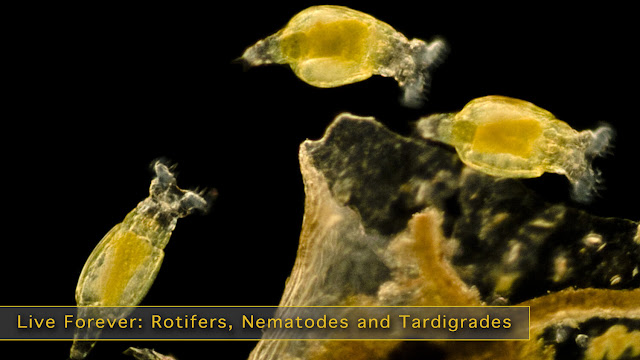
 Rotifers (Philodina sp.), Light Micrograph


The bdelloid rotifer, found in freshwater habitats all over the world, is able to withstand extreme cold. According to a recent discovery in northeastern Siberia, these multicellular organisms can be frozen for up to 24,000 years and live to tell the tale!

The average life span of us humans, 78 years, is not much compared to other creatures. Some birds live up to 100 years, eels have been recorded at 106, tortoises 150, and Koi fish over 200. The slow moving Greenland shark has been recorded at 512 years.

Still these are just flashes in the pan compared to rotifers. Scientists recently restored rotifers that had been frozen in the Siberian permafrost for over 24,000 years, meaning these creatures were alive during the Late Pleistocene Era - when Wooly Mammoths roamed the earth.

Stock Images and Video of Rotifers and Other Long-lived Animals

A rotifer is part of a group of seemingly invincible creatures, such as nematodes and tardigrades. Tardigrades have even been sent to outer space and survived.

Rotifers are a type of microscopic animal that is often found in zooplankton in either freshwater or saltwater. Rev. John Harris, in 1696, was the first to mention these creatures. They are commonly referred to as wheel animals due to the motion of the cilia surrounding their mouths, which looks like a spinning wheel.

Rotifers are filter feeders that eat dead bacteria and other decaying organic matter. When they move around, they compress their bodies into round shapes and extend out into a long thin shape. In terms of size they can range from 50 micrometers to over 2 millimeters.


Thursday, September 26, 2019

Plastic is Deadly

Young Northern Fur Seal tangled in a nylon rope and dragging nets, cables, and fishing wires, doomed to die of hunger.
While plastic items in our daily lives are designed for one-time use, they have a long life span, usually up to 1,000 years.
Plastic is also deadly. People consume thousands of plastic articles each year, which damage our health, especially our immune systems. Plastic particles are even in the air we breathe, floating in the remotest places from fields to mountains.
For many animals plastic is lethal. Sea birds get caught in plastic fishing line and starve to death. Small mammals choke and die in 6-pack plastic rings. Dolphins and whales swallow plastic particles that block up their bodily systems. Sea turtles suffocate in plastic bags and floating debris prevents them from surfacing for air.
Luckily, as awareness grows, people are working to clean up plastic in the environment. New types of safe, biodegradable plastic are also coming on the market. We have a very long road ahead, but with more awareness and countries working towards a common goal, we have a more hopeful future.
plastic pollution, wildlife, animals, plastic in our lives

Marine Animal Custom Gifts: Framed Prints, Tote Bags, Note Books, and More…

Rotifers, Nematodes and Tardigrades Stock Microscopic Photography

 Roti fers (Philodina sp.), Light Micrograph The bdelloid rotifer, found in freshwater habitats all over the world, is able to withstand ex...