Pages

Showing posts with label water bear. Show all posts

Friday, September 8, 2023

Rotifers, Nematodes and Tardigrades Stock Microscopic Photography


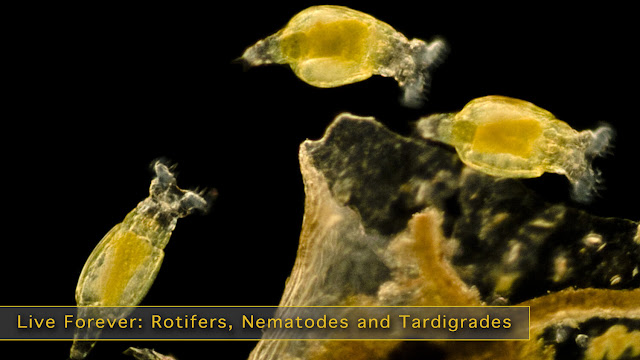
 Rotifers (Philodina sp.), Light Micrograph


The bdelloid rotifer, found in freshwater habitats all over the world, is able to withstand extreme cold. According to a recent discovery in northeastern Siberia, these multicellular organisms can be frozen for up to 24,000 years and live to tell the tale!

The average life span of us humans, 78 years, is not much compared to other creatures. Some birds live up to 100 years, eels have been recorded at 106, tortoises 150, and Koi fish over 200. The slow moving Greenland shark has been recorded at 512 years.

Still these are just flashes in the pan compared to rotifers. Scientists recently restored rotifers that had been frozen in the Siberian permafrost for over 24,000 years, meaning these creatures were alive during the Late Pleistocene Era - when Wooly Mammoths roamed the earth.

Stock Images and Video of Rotifers and Other Long-lived Animals

A rotifer is part of a group of seemingly invincible creatures, such as nematodes and tardigrades. Tardigrades have even been sent to outer space and survived.

Rotifers are a type of microscopic animal that is often found in zooplankton in either freshwater or saltwater. Rev. John Harris, in 1696, was the first to mention these creatures. They are commonly referred to as wheel animals due to the motion of the cilia surrounding their mouths, which looks like a spinning wheel.

Rotifers are filter feeders that eat dead bacteria and other decaying organic matter. When they move around, they compress their bodies into round shapes and extend out into a long thin shape. In terms of size they can range from 50 micrometers to over 2 millimeters.


Saturday, May 19, 2018

Invincible Water Bears


Although they can survive unprotected in outer space, these resilient creatures are terrestrial living beings, not aliens as some have claimed. They are found on every continent on planet Earth and they love the water, yet can be found in the desert as well.

First discovered by pastor and zoologist Johann Goeze in 1773 and later named Tardigrada (Italian for "slow stepper"), these creatures still fascinate scientists today.

Images & Video of Tardigrades

It's unlikely that Goeze knew how amazing tardigrades (also called water bears) really are. They can withstand a high temperature of 300 degrees and a low of -458 degrees F. They have also survived outer space, radiation, and six times the pressure of the deep sea.

How do they do this? When faced with adverse conditions they can desiccate - dry up - themselves. When in this state they are referred to as 'tuns' and resemble a little ball. It is a death-like state called cryptobiosis. Water bears usually only live a few weeks or months but can be revived from a state of cryptobiosis after 30 years.

Water bears need at least a small film of water to be in their normal mobile state. They suck water from the moss and plant matter they usually live in. They prefer living in the moist sediment in the bottom of lakes but have been found in arid regions as well. As long as there is just a little water, they can thrive.

Cute Water Bear Throw Pillows

Even though human beings might not survive a catastrophe such as a supernova or asteroids, it seems that water bears will be around many millennia after we are gone.


Alina Bradford, Tardigrade Facts, livescience.com
William Herkewitz,  Secrets of the Water Bear,  popularmechanics.com
wikipedia.com

Rotifers, Nematodes and Tardigrades Stock Microscopic Photography

 Roti fers (Philodina sp.), Light Micrograph The bdelloid rotifer, found in freshwater habitats all over the world, is able to withstand ex...