Pages

Showing posts with label t-shirts. Show all posts

Sunday, November 28, 2021

Microscope Photography (SEMS) Make Unique Gifts for the Science Minded


Woman uses a Scanning Electron Microscope (left) , a cell heavily infected withARS-CoV-2 virus particles (right).

 The entire world has become more familiar with micrographs in the past 18 months, although you may not have realized it. During the pandemic, detailed photographs of the coronavirus appeared in newspapers, television, and everywhere online.  They were taken by a particular device called a scanning electron microscope. The images are often referred to as SEMs for short.

As the name implies, the microscope uses a particle beam to detect electrons off the surface of specimens, which is then placed in a vacuum to create sharp images. Magnification ranges from 20x to 30,000x, spatial resolution of 50 -100nm.

Micrographs allow us to see critical details that may be useful in curing diseases, and they shows us the hidden beauty of everyday objects.


A fine art print, a fun t-shirt, mug, or jigsaw puzzle of a micrograph will make a bold impression on anyone. Resembling abstract art, they’re great for people in the sciences, medicine, research, or just someone who enjoys nature. Discover what micrograph gifts you can make!


Peruse these fascinating images at our Fine Art America shop to start creating amazing micrograph gifts!


Thursday, January 31, 2019

Alchemy and the Road to Science


Today alchemy conjures up images of boiling cauldrons and magic elixirs, but the past reveals its lasting impact on the foundation of science.

Alchemy began in ancient Egypt, sometime between the 4th and 3rd century BC, with the aim of transmuting base metals (i.e led) into noble metals, such as gold.

In the 8th century AD, Arab alchemists invented the first laboratories for transmutation, creating complex methods of classification and documentation. Jabir ibn Hayyan and Muhammad ibn Zakarīya Rāzi even made breakthroughs in chemistry, discovering sulfuric and hydrochloric acid.

Alchemy Stock Photos

Islamic alchemy inspired the later European search for the philosopher’s stone, an object believed to turn base metals into gold and bestow its owner with eternal life. The investigation lasted hundreds of years and although unsuccessful, produced countless experiments and lengthy chronicles of their results.

The pursuit of the philosopher’s stone was echoed in China by the search for the elixir of immortality. Like the Europeans, the Chinese alchemists believed in the medicinal power of metals and used them in their potions. Famously, the Jiajing Emperor of the Ming Dynasty drank a fatal dosage of mercury, believing it was the famed elixir.

During the 17th century, Robert Boyle invented modern methods of chemical investigation. Boyle’s highly controlled experiments made alchemy appear blunt and archaic. Alchemy became associated with superstition and the occult and quickly fell out of favor.

Although it had a brief revival in the 18th century with the spiritualist movement, alchemy remained the fancy of counter culture.

While alchemy’s past may be meandering and at times ridiculous, its impact on science and the world that followed is undeniable. For more alchemy images click the links above and be sure to check out our storefront for great chemistry products!

Chemistry Handbags, Mugs and Notebooks

  • wikipedia.com
  • Britannica.com
  • Smithsonian.com

Sunday, October 14, 2018

Explore the Human Microbiome


The idea of bacteria creeping through your body might be less than appetizing. We often associate the presence of bacteria in our bodies (especially in our digestive system) with infections, viruses, and food poisonings. However, scientific findings have uncovered the fact that there are also many types of good bacteria that are essential to our health. This collection of good and bad bacteria within our bodies have also been discovered to be strikingly diverse from person to person.

The definition of the human microbiome is still somewhat ambiguous and disputed but is commonly known to be the vast ecosystem of microscopic organisms (microbes) living within us. According to the National Center for Biotechnology Information (NCBI), we consist of 10-100 trillion microbiota, also known as microbial cells. These cells hold genes that determine cell behavior.

Stock Images and Stock Video of Microbes


Scientists have become specifically interested in the gut (our stomach and intestines) as a location that holds a notably vast collection of microbes. Believe it or not, the large intestine houses good bacteria, such as probiotics, that fight the bad bacteria and keeps us healthy. The ratio of good bacteria to bad can change and partly depends on your immune system or diet choices. If good bacteria becomes low in numbers, risk of infection and virus development increases.

One of the fascinating aspects of our microbiomes is that everyone's is distinctly unique. We, as humans, have a much different microbiome than other animals, but ours also differ from person to person. Even the collection of organisms in your mouth is different than the community of organisms in your gut.

Because each person's microbiome is so individualized, researchers are recognizing that this information could be valuable for practical usage in medicine. A patient's microbiome could be used similarly to a fingerprint, but instead of merely identifying the patient, medical professionals could gain a better understanding about what is going on within the patient's body and be able to make more educated predictions about procedures and treatments needed.

Microbial Mugs, Notebooks, and Other Custom Gifts


As more and more scientific findings of this topic surface, it becomes increasingly more exciting to find out how this knowledge will help us solve many unanswered questions that have to do with anatomical behavior, virus prevention, and even evolution. Our microbiomes seem to be the mysterious key that could open many doors to the understanding of the human body.


  • learn.genetics.utah.edu/content/microbiome
  • https://www.ncbi.nlm.nih.gov/pmc/articles/PMC3426293
  • http://www.nutritionnews.abbott/nutrition-as-medicine/the-role-of-the-microbiome-in-gut-health-

Wednesday, September 26, 2018

They'll Hijack Your Body to Replicate Themselves


Zombies? Science Fiction? Fantasy? No, it’s the very real flu virus, cold virus, rabies, HIV, ebola or any other viruses.

Viruses are microscopic nonliving organisms that can only reproduce by hijacking the production mechanism inside a living host’s cells. The virus replicates itself until the cell bursts, spreading the virus further. This usually means death to each cell that becomes infected. If the host’s immune system cannot destroy the virus, ultimately it can mean a very bad outcome for the host as well.

They differ from bacteria in that bacteria are alive, reproduce through fission (splitting apart) and carry on metabolic functions such as digestion.

Stock Images of Bacteria and Viruses

Viruses cannot reproduce on their own. They need to attach themselves to a host’s cells and inject it with their DNA/RNA, taking over the cell’s “machinery” to manufacture and reproduce. This continues until the cell literally bursts. The new viruses go on the hunt for more cells to continue this cycle.

Viruses are 10 to 100 times smaller than bacteria. Common water filters can block bacteria, however viruses can pass through many common filters.

Many bacteria are beneficial and even necessary for human existence. Our digestive tracts are filled with good bacteria - Normal Flora - that help break down food and even produce vitamins, such as vitamin K, that are critical to our well-being.

We all know there are also harmful bacteria such as Streptococcus pyogenes that causes strep throat or E. coli that causes food poisoning.

But there are no beneficial viruses that we know of. In fact, a type of virus called a bacteriophage even infects and kills bacteria.

Viral & Bacterial T-shirts, Bags and More…

Antibiotics are useless against viruses. Antibiotics only kill off bacteria, which is why doctors will only prescribe them once they are certain an illness is caused by a bacteria and not a virus.

Even though antiviral drugs do exist, they aren’t even able to kill viruses. They only limit a virus’s ability to develop further.

The best methods for keeping safe from these dangerous invaders in the first place is to practice basic hygiene and common sense. Washing your hands frequently, getting the flu shot, staying clear of wild animals that may carry rabies such as raccoons and avoiding contact with anyone already infected especially if they coughing or sneezing, are some of the leading precautions you can take.

  • webmd.com
  • wikipedia.com
  • sciencedaily.com

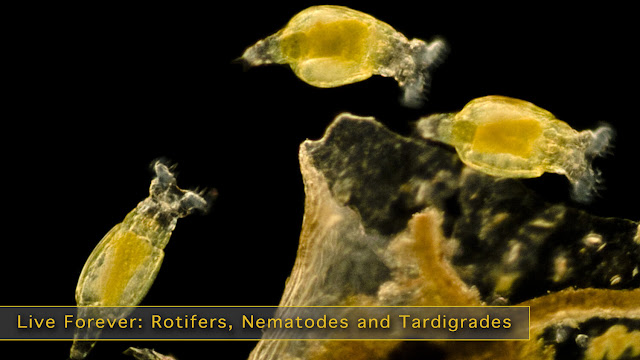
Rotifers, Nematodes and Tardigrades Stock Microscopic Photography

 Roti fers (Philodina sp.), Light Micrograph The bdelloid rotifer, found in freshwater habitats all over the world, is able to withstand ex...