Pages

Monday, May 20, 2019

How 3D Medical Animation is Changing the Way We Learn


Many of us remember taking biology and anatomy courses in high school or college. We would peer into our textbooks and try to soak in the labels attached to an illustration of an animal cell. Some of us were lucky enough to crowd around a model of a skeleton at the front of the class and watch the instructor point out important anatomical landmarks.

Those of us who were able to observe a physical model of a biological structure may have noticed that it was much easier to retain information if we could see a 360-degree view of the object. If we could hold it in our hands, turn it around to look at the front and back, and maybe take different pieces of the model apart, we were able to interact with the structure enough to feel more familiar with how it looked and what the nomenclature was.

RF and RM Videos of 3D Medical Animations

Unfortunately, it is nearly impossible for a classroom to have physical models of every scientific topic that needs to be learned. However, the birth of 3D animation has made it possible for us to watch countless structures move, be taken apart, and rotate 360-degrees.

3D animations are composed of 3D models, which in the most basic terms are digital sculptures, that are manipulated and moved around throughout the course of the video. Surprisingly, the process used to make 3D models is just as mathematical as it is design-oriented. An artist is essentially creating instructions for a computer to follow in order to create the model, thus equations and geometry are taken into account to ensure that the computer is able to process the object without experiencing glitches.

Because these models are crafted to represent 3D objects or a 3D terrain, they open up the doors to a digital world that mimics the physical world we live in. 3D medical animation can exhibit clinically accurate surgeries, obscure biological processes, and isolated molecules or anatomical parts.

Instead of staring at a book and reading complicated descriptions about how our bodies work, viewers with access to computers can now watch different parts of the brain light up in glowing colors in order to learn the nomenclature, or observe the motion of glucose molecules as they interact with other structures to pass through a cell membrane.

Studies show that if viewers can be presented with learning material that connects with their creative side, the lesson will not only grab more of the audience’s attention, but will allow the audience to retain the information better because they are having fun watching the video as more active participants.

Science coffee mugs, notebooks, tote bags, and more!

Businesses surrounding 3D animation have been responding in parallel to these communication benefits. The Market Research Gazette reports that the market has been projected to grow by 20.8% from 2016 to 2021.

As medical animation becomes more popular and receives more funding, animations will become more accessible to more learners worldwide, which will create a brighter future for our students and our healthcare.

Biology-themed Notebooks, Tote Bags, Coffee Mugs, and More

  • amarketresearchgazette.com
  • baltimorepostexaminer.com
  • cgspectrum.edu.au
  • sculpteo.com
  • TemJournalAugust2018_670_677

Thursday, May 16, 2019

NASA and the Space Age


In 1957, an amazing spectacle appeared in the North American night sky – Sputnik, the first satellite to enter Earth’s orbit. The USSR had successfully sent a rocket into outer space, thus beginning the space race, an event which would last a decade and challenge the best and brightest of two nations.

In response to Sputnik, President Dwight D. Eisenhower created NASA, the first American administration for space exploration in 1958. With Project Mercury, NASA attempted to make the first manned mission into space but failed to beat the Russians, who sent Yuri Gagarin into orbit in 1961. A month later Alan Shepard became the first American in space and John Glenn followed soon after, orbiting the Earth three times in 1962.

Gallery of NASA Stock Images and Videos

In the Sixties, NASA entered a new era. With the cold war raging and the threat of nuclear armament on the horizon, President John F Kennedy vowed to redouble NASA’s efforts and put an American on the moon by the end of the decade. In 1965, NASA began the Spacelab project, sending the first space station into Earth’s orbit. Despite sustaining damage during take off, the station was repaired in space and orbited the Earth until 1979.

The success of Spacelab led to NASA’s famous Apollo missions to the moon. After many failed attempts, Apollo 8 became the first shuttle to circle the moon in 1968. The following year, the USSR accomplished its first moon tour, leaving the space race at a stalemate.

Astronomy phone cases, tote-bags and more!

With the cold war raging in the east, astronauts Buzz Aldrin and Neil Armstrong of Apollo 11 successfully landed on the moon in 1969. The mission effectively ended the space race and cemented America’s place as the world leader in space exploration. Buzz Aldrin and Neil Armstrong became national heroes and were awarded the Presidential Metal of Freedom later that year.

Since then, NASA has continued its exploration of space sending probes to every planet in our solar system, including the dwarf planet, Pluto. It also landed four rovers on Mars, the last of which, Curiosity, is still collecting data from its craters today.

The recent image of a black hole in the M87 galaxy is more proof of human potential in space exploration. For the Space Age to advance, we must continue NASA’s legacy into the future. For more astronomy images check out the gallery above, and for unique astronomy gifts check out our store front below.

Astronomy Phone Cases, T-shirts and More

nasa.com
nytimes

Monday, May 13, 2019

Don't Sweat It: How Mosquitos Find Us


Scientists recently came one step closer to figuring out how to stop mosquitoes from biting us.

Mosquitos have plagued humans and other warm-blooded mammals for eons. Aside from ruining an otherwise beautiful summer evening with their itchy bites, they transmit some of the worst diseases known to man. Malaria, zika, yellow fever, dengue, West Nile Virus, encephalitis, and chikungunya are some of the deadliest.

RF & RM Stock Images of Mosquitos

Many of these have no cure and may cause congenital disabilities or death.

In the United States West Nile virus, eastern equine encephalitis, western equine encephalitis, St. Louis encephalitis, La Crosse encephalitis, dengue, and yellow fever are all transmitted by mosquitoes.

The good news is that scientists continue to discover precisely how mosquitoes find us? It will help us figure out how to stop them from biting us.

The recent finding confirms that it is the acids in our sweat that attract them. Genetically altered mosquitoes that couldn't sense these acids were not drawn to us.

For now, the best method is still to use repellent with DEET (N,N-diethyl-meta-toluamide) or another chemical that masks the smell of our sweat.

The future is looking brighter than ever for us to prevent mosquito bites and thereby eradicate many diseases.

Monday, March 18, 2019

The Women of Coding

In 1833, Lady Ada Lovelace, the only legitimate daughter of Lord Byron, became the first computer programmer when she created a machine for computing called the Analytical Engine. Her partner, Charles Babbage, designed the hardware, while Lovelace focused on the machine’s inner workings or what we now call “software.” Bringing the machine to its absolute limit, Lovelace published the first computer algorithm in 1843.

Lovelace’s legacy would continue into the 20th century, as women entered the workforce. While men were busy fighting WWII, a group of female computer scientists, including Betty Holberton, Kay McNulty, Marlyn Wescoff, Ruth Lichterman, Fran Bilas and Betty Jean Jennings programmed the ENIAC, one of the first general purpose computers. Although they were called “subprofessionals” by their peers and “refrigerator girls” by historians, Hoberton and her team used ENIAC to make crucial calculations on the trajectory of ballistic missiles for the US and its allies.

View More Women of Coding

The military would give rise to another great coder when Grace Hopper, a professor and computer scientist, joined the navy reserve and developed one of the earliest programming languages, COBOL. Hopper went on to create the first compiler, a device for synthesizing written language into code. By the end of her career, she had risen to the rank of rear admiral and even got a US destroyer named after her.

Science cell phone cases, mugs, tote bags, and more!

In the 1980’s women’s participation in coding suddenly dropped. While the reason is unknown, Sara Kiesler, a social scientist, believes the advent of personal computers was chiefly responsible. Kielfer argues that when computers entered the home, parents made them the domain of boys and not girls. The culture surrounding tech became male-dominated and many women decided to opt out of the field completely. Female participation in programming was cut in half, and today only 18 percent of computer science graduates are women.

If you have a daughter or niece this Women’s History Month, encourage their interest in computers! Tell them that a career in coding is a girl thing too and that they can make history!

Click the link above to see more great female programmers and check out our storefront for great science gifts.

Science Prints, Mugs, Phone Cases and More

  • nytimes.com
  • history.com

Monday, March 11, 2019

Climate Change, Extreme Weather and the Jet Stream


In the last decade or so, we’ve experienced giant tornados, damaging wildfires, flood-inducing rainstorms, fatal heat waves, and droughts destroying crops and livestock like never before.

At the same time the polar jet stream, a westerly wind generated by solar radiation and the corollas effect (a phenomenon that creates our weather), has been behaving in unprecedented ways. Scientists believe this is not a coincidence, rather it is related.

Stock Images of Climate Change,
Extreme Weather and the Jet Stream

Normally, the jet stream travels either in a straight line or undulates in waves called Rossby waves. Rossby waves bring warm air northward and cold air southward. This can create a temporary heat wave or a rainstorm.

The jet stream is powered by the temperature differential between the cold arctic air and the warmer air in the lower latitudes. As global warming continues to warm the arctic air, the jet stream is losing its power. The Rossby waves have become larger, expanding much further north and south than before.

They are bringing temperatures and weather that is unusual for our local climate. Records show that Southern U.S. states now get snow more regularly than in the past.

Once Rossby waves, especially weakened ones, reach a certain size they can stall in place, permitting a heat wave or a rain weather system to last days or weeks longer than the norm.

With no end in sight to global warming or even a slowing of it, we are likely to be in for even more extreme weather that increases in intensity and stays put for longer.

Fine Art Prints of Wild Weather on Metal & Canvas

A growing number of scientists are predicting that perhaps as soon as 2050 the climate in the southern latitudes may be unlivable and the Arctic could be our new temperate zone.

Get ready to move north, and bring your umbrella, sunscreen and snow boots.


  • wikipedia.com
  • scientficamerican.com
  • sciencefriday.com

Thursday, January 31, 2019

Alchemy and the Road to Science


Today alchemy conjures up images of boiling cauldrons and magic elixirs, but the past reveals its lasting impact on the foundation of science.

Alchemy began in ancient Egypt, sometime between the 4th and 3rd century BC, with the aim of transmuting base metals (i.e led) into noble metals, such as gold.

In the 8th century AD, Arab alchemists invented the first laboratories for transmutation, creating complex methods of classification and documentation. Jabir ibn Hayyan and Muhammad ibn Zakarīya Rāzi even made breakthroughs in chemistry, discovering sulfuric and hydrochloric acid.

Alchemy Stock Photos

Islamic alchemy inspired the later European search for the philosopher’s stone, an object believed to turn base metals into gold and bestow its owner with eternal life. The investigation lasted hundreds of years and although unsuccessful, produced countless experiments and lengthy chronicles of their results.

The pursuit of the philosopher’s stone was echoed in China by the search for the elixir of immortality. Like the Europeans, the Chinese alchemists believed in the medicinal power of metals and used them in their potions. Famously, the Jiajing Emperor of the Ming Dynasty drank a fatal dosage of mercury, believing it was the famed elixir.

During the 17th century, Robert Boyle invented modern methods of chemical investigation. Boyle’s highly controlled experiments made alchemy appear blunt and archaic. Alchemy became associated with superstition and the occult and quickly fell out of favor.

Although it had a brief revival in the 18th century with the spiritualist movement, alchemy remained the fancy of counter culture.

While alchemy’s past may be meandering and at times ridiculous, its impact on science and the world that followed is undeniable. For more alchemy images click the links above and be sure to check out our storefront for great chemistry products!

Chemistry Handbags, Mugs and Notebooks

  • wikipedia.com
  • Britannica.com
  • Smithsonian.com

Friday, January 11, 2019

Have We Found the True Cause of Alzheimer's?


Alzheimer’s has been a mysterious disease ever since it was discovered. Considered to be a condition that fits into the dementia category, Alzheimer’s disease is characterized by physical changes in the brain that deteriorate brain function, cognitive ability, and memory in a certain pattern. People who are at least 65 years old are most often affected, however, there are also early-onset cases.

The progression of Alzheimer’s happens over decades and since the brain is such a complicated organ, it has been difficult for scientists to study.

The brain of the patient that had the first named case of Alzheimer’s disease was found to have amyloid (protein) plaques and tao tangles (tangles of fibers) within it. These abnormalities have long been considered by medical professionals to be one of the main causes of the disease, however recent studies suggest that the true cause could be another condition that happens initially, and this abnormal tissue growth may be a secondary symptom.

Stock Images and Stock Video of Alzheimer’s Disease

Scientists came out with new research this year that highlights chronic inflammation as one of the possible causes, based on the body’s tendency to kill off cells or change the genetic code within cells when inflamed for a long period of time. Alzheimer’s is considered a genetic disorder, meaning that it is caused by mutated genes. This also means that the disease can be inherited from a family member. Because the gene mutation that chronic inflammation causes can get worse as the body ages, it makes a good parallel to the fact that Alzheimer’s usually sets in at an older age.

Although inflammation seems to be a viable candidate, many studies still need to be conducted to see if anti-inflammatory drugs ease the progression or onset of Alzheimer's and dementia.

Currently, there are studies being conducted to find out if we would be able to use an existing anti-inflammatory drug as a treatment or preventative measure. If one is found to work, it would be more accessible to obtain as well as cheaper for both the patient and developers.

At this point in time Alzheimer’s is incurable and lifelong, however, if we are able to pinpoint the cause of this condition we will be able to prevent the onset of the disease and will be well on our way to finding a cure.

  • medicalxpress.com/news/2018-09-scientists-reveal-ground-breaking-alzheimer-disease
  • alz.org
  • nia.nih.gov/health/alzheimers-disease-fact-sheet
  • sciencedaily.com/releases/2018/05/180502104103.htm

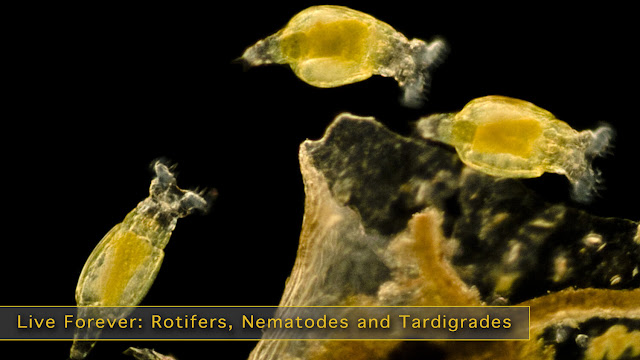
Rotifers, Nematodes and Tardigrades Stock Microscopic Photography

 Roti fers (Philodina sp.), Light Micrograph The bdelloid rotifer, found in freshwater habitats all over the world, is able to withstand ex...